Publications

See the descriptions and links to published research below. Contact me with questions, requests for replication data, etc. Access my academic CV for more details about my scholarly work and appointments.

Quality Control

Austin Hart & J. Scott Matthews
Cambridge University Press (2023).
We develop a new experimental and theoretical framework for studying how – and how well – voters assess their government’s performance in office. We present the first extensive experimental investigation of how voters perform two tasks that are central to the democratic logic of retrospective voting: the integration of information regarding government performance into a summary impression, and the appraisal of that information for use in vote decisions.
Unmasking Accountability

Austin Hart & J. Scott Matthews
Journal of Politics (2022).
As local conditions come to reflect extralocal forces, signals of government competence grow more obscure. Yet we know relatively little about how voters evaluate incumbent performance in the context of interdependence. We use a series of simulated voting tasks to examine three theoretical possibilities: blind retrospection, rational discounting, and benchmarking.

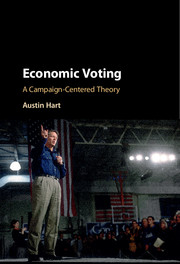
Economic Voting

Austin Hart
Cambridge University Press (2016)
Drawing on cognitive-psychological research on priming, I show that the intensity of voters’ exposure to economic campaign messages systematically conditions the strength of the economic vote. More than ‘campaigns matter,’ I argue that candidates who control the campaign narrative can capitalize on favorable economic conditions or - contrary to the predictions of conventional theory - overcome unfavorable conditions.

Priming Under Fire

Austin Hart & Joel A. Middleton
Journal of Politics (2014).
We reevaluate the classic “media priming” hypothesis, which argues that, when news coverage raises an issue’s salience, voters align their overall evaluation of the president with their assessment of him on that issue. We conduct a two-wave survey experiment to disentangle priming from the opposite causal process: projection.

Can Candidates Activate or Deactivate the Economic Vote?

Austin Hart
Journal of Politics (2013).
Do electoral campaigns affect the strength of the economic vote? Against the conventional expectation that candidates have little influence over when and to what extent economic voting occurs, I argue that political communications systematically condition voters’ willingness to hold candidates responsible for past economic performance. Evidence from 2000 and 2006 Mexican Presidential elections.